
How Loan Creep Is Quietly Stealing Profit from Your Landscape Business
One of the easiest ways to put pressure on cash flow is also one of the easiest mistakes to justify.
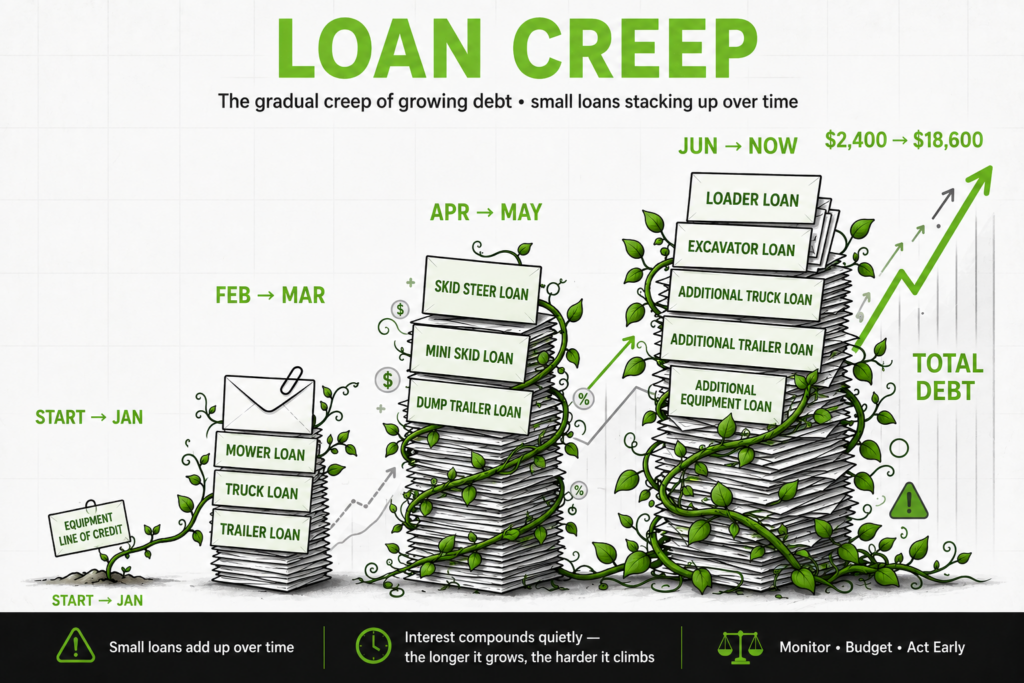
It usually begins with a loan that makes perfect sense. You finance a new mower because it will improve efficiency. Later, you finance a trailer to support your growing fleet. Before long, another opportunity comes along, and the monthly payment on a truck, skid steer, or another piece of equipment seems just as manageable as the last one. None of those decisions feels risky on its own because you are only looking at one payment at a time.
However, over time, those individual loan payments begin to stack together until your business is carrying thousands of dollars in fixed monthly obligations before you have paid your employees, purchased materials, filled the fuel tanks, or set aside a dollar for profit.
I call this loan creep, and I see it far more often than most landscape business owners realize.
There is nothing inherently wrong with financing equipment. In many cases, it is a smart business decision that allows you to increase production, improve efficiency, and continue growing your company. The problem begins when financing becomes a habit instead of a strategy. Every new loan may make sense on its own, but when you fail to look at the cumulative impact of those payments, your cash flow slowly becomes restricted without you realizing it.
The result is a business that looks successful on paper but constantly feels short on cash.
Why Loan Creep Is So Dangerous
Loan creep rarely creates immediate financial stress, and that is exactly what makes it so dangerous.
Most owners evaluate financing one purchase at a time. The payment seems affordable, the equipment promises greater efficiency, and the return on investment appears reasonable. After the paperwork is signed, the equipment goes to work and the payment simply becomes part of doing business. Months later, another opportunity presents itself and the same thought process repeats.
Eventually, those individual decisions become one large financial commitment.
Instead of looking at a single monthly payment, the business is now responsible for several thousand dollars in debt before payroll is processed, fuel is purchased, materials are ordered, or profit is allocated. The equipment may be generating revenue, but the debt has quietly reduced the flexibility of the business.
One of the most important lessons I have learned working with landscape companies is this:
Every loan you take out is a claim against your future cash flow.
Revenue will fluctuate, equipment payments will not.
Cash Flow Does Not Care Why You Borrowed the Money
One of the principles I teach through Profit First is that cash flow tells the truth.
Your Profit and Loss Statement may show a profitable business, but your bank account tells you whether the business actually has money available to operate. Loan payments create fixed obligations that must be made regardless of how much revenue comes in that month.
Landscape companies do not experience consistent revenue throughout the year. Weather delays happen, customers postpone projects, commercial contracts change and a rainy week can dramatically reduce production, but the loan payment remains exactly the same.
That is when business owners begin feeling the squeeze.
The issue is rarely that the equipment was a poor investment. More often, it is that the business has accumulated far too many fixed payments, leaving very little room to absorb the normal fluctuations that occur in a seasonal industry. When cash flow becomes tight, decision making becomes reactive, and protecting profit becomes increasingly difficult.
What Your Profit and Loss Statement Is Not Showing You
One of the reasons loan creep often goes unnoticed is because many owners rely exclusively on their Profit and Loss Statement to evaluate the health of the business.
From an accounting perspective, only the interest portion of a loan payment appears as an expense. The principal payment reduces a liability on the balance sheet, so it never appears on your Profit and Loss Statement. While that treatment is correct from an accounting standpoint, it does not change the fact that the entire payment leaves your bank account every month.
That is why many landscape business owners tell me, “My accountant says I’m making money, but I never seem to have any cash.”
The Profit and Loss Statement measures profitability. Cash flow measures reality.
This is one of the reasons I appreciate the Profit First system so much. Profit First forces owners to look at cash differently. Instead of assuming the balance in the operating account is available to spend, every dollar is assigned a purpose. Money is allocated first to profit, owner’s pay, taxes, and operating expenses. When debt payments begin consuming too much of the operating expense account, you see the problem immediately instead of discovering it months later.
That visibility changes the conversation. Instead of asking whether you can afford another payment, you begin asking whether your business should take on another payment.
Those are two very different questions.
Evaluate Your Debt Before It Becomes a Problem
One exercise I encourage every landscape business owner to complete at least once each year is to calculate the true cost of recurring debt.
Add together the monthly payments for all business debt, including:
- Equipment loans
- Vehicle financing
- Trailer loans
- Lines of credit with scheduled payments
- Any other recurring business debt
Once you have that total, compare it with your average monthly revenue, not your best month of the year.
If those payments consume more than fifteen to twenty percent of your average monthly revenue, it is worth taking a closer look at your debt strategy. Every additional payment reduces your ability to respond to unexpected expenses, weather interruptions, or seasonal slowdowns.
The goal is not to eliminate every loan. The goal is to understand how much of your future revenue has already been committed before the month even begins.
Awareness is the first step toward better financial decisions.
One Simple Strategy That Can Save Thousands
If your cash flow is stable and your lender allows additional principal payments without penalty, consider making your loan payments every two weeks instead of once each month.
For example, if your monthly payment is $1,000, you could instead pay $500 every two weeks. Because there are twenty six biweekly payment periods in a year, you effectively make the equivalent of one additional monthly payment annually.
That extra payment goes directly toward reducing principal, allowing you to pay off the loan sooner while reducing the total amount of interest paid over its life.
More importantly, every loan you eliminate creates additional cash flow. The sooner debt disappears, the sooner that monthly payment becomes available for profit, growth, owner distributions, or future investments that strengthen the business.
Before implementing this strategy, review your loan agreement to confirm there are no prepayment penalties and that additional payments are applied directly toward principal.
Equipment Should Build Profit, Not Consume It
Before financing your next piece of equipment, ask yourself one simple question:
Can my slowest month of the year comfortably support this payment while still allowing me to pay myself, allocate profit, cover taxes, and operate the business confidently?
If the answer is no, the equipment may not be as affordable as it appears.
Growth should create more financial freedom, not more financial pressure. Equipment should increase profitability, improve efficiency, and strengthen cash flow. If financing begins reducing your flexibility instead of improving it, loan creep has already started to take hold.
Build a Stronger Financial Foundation
Loan creep does not happen overnight, and it rarely announces itself. It develops one payment at a time until cash flow becomes constrained and profitability becomes harder to achieve.
The good news is that it is completely preventable.
When you understand how debt affects cash flow, regularly evaluate your fixed financial obligations, and use Profit First to intentionally allocate every dollar your business earns, financing becomes a strategic tool instead of a financial burden.
At The Green Executive®, we help lawn care and landscape business owners build businesses that are profitable, financially healthy, and prepared for long term growth. If you are wondering whether loan creep is limiting your business’s potential, let’s have a conversation. Together, we can evaluate your current financial picture, strengthen your cash flow strategy, and build a business where every financial decision supports greater profitability instead of creating additional pressure.